Volatility Trading Course — Vol Surfaces, Vega, And Dispersion
A volatility trading course delivered by a collective of anonymous senior desk traders. Vol as the asset itself — surfaces, skew, term structure, vega, variance, dispersion. The volatility trading course that mirrors real institutional vol practice.
Why this volatility trading course exists
Volatility is the most mispriced asset class in the retail market. The reason is simple: almost no one is teaching it properly. Search "volatility trading course" and the results are mostly the same recycled options content — iron condors, short strangles, calendar spreads — sold by marketing-first "trading academies" that have never managed a real vol book through a regime change. The retail trader buys the course, sells premium for six months, then gets liquidated on the first vol spike.
This volatility trading course is built by people who actually run vol books. The desk is a collective of anonymous senior derivatives professionals — cumulative decades of vol-book experience across equities, FX, rates and commodities. By policy the instructors of the volatility trading course remain anonymous: the content and the daily mentorship are the product. The team does not sell faces; they sell the methodology a real vol trader uses every day.
That methodology turns volatility into a tradeable asset. The volatility trading course teaches you to read the surface as a structure, not a single number; to think in vega before you think in delta; to identify regimes before the market does; to size correctly so you survive the vol spike that destroys the income-fund crowd every two years.
What you will learn in this volatility trading course
Module 1 — Vol as an asset class
Implied vs realised volatility, vol risk premium, why vol pays in the long run. The conceptual foundation of any serious volatility trading course.
Module 2 — The full vol surface
Skew, smile, term structure, surface dynamics, surface arbitrage. How the surface deforms in stress regimes — and how to trade those deformations.
Module 3 — Vega and dealer vega
Vega across strikes and tenors, vega budgets, dealer aggregate vega. The volatility trading course material that almost no other course teaches.
Module 4 — Variance and volatility products
Variance swaps, volatility swaps, VIX-style indices, vol-of-vol products. How they price, how they hedge, when they are tradeable.
Module 5 — Dispersion trading
Long single-name vol, short index vol — one of the most profitable structures on a real vol desk. The volatility trading course dissects pricing, hedging and execution end to end.
Module 6 — Vol regime detection
Calm vs stress, term structure shape, dispersion signals, cross-asset vol confirmation. Reading the regime before the regime announces itself.
Module 7 — Live execution of vol trades
You watch vol structures being entered, sized, hedged, rolled and exited live. Real bid-ask, real slippage, real decisions throughout the volatility trading course.
Module 8 — Vol risk management
Vega caps, scenario stress, tail-risk overlays, sizing under vol uncertainty. The discipline that distinguishes a real vol trader from a premium-seller.
Daily mentorship inside the volatility trading course
The video curriculum is the foundation, but the volatility trading course really compounds inside the daily mentorship layer. Every day, the desk posts live commentary in the private Whop community: surface observations, dealer vega reads, regime change signals, active vol trades. It is the closest thing a serious vol learner can get to sitting next to a real vol desk.
When the surface does something unusual — an inverted term structure, a violent skew flip, a vega-driven cross-asset move — the desk explains it in near real-time. You see the read, you see the trade idea, you see the sizing. That is how a volatility trading course becomes operational instead of theoretical.
No comparable volatility trading course in the public market combines this depth of curriculum with this density of daily mentorship from a real desk.
Follow the desk
Public channels of the trading desk. Free preview of the teaching approach and live commentary.
Before subscribing to the full volatility trading course on Whop, you can sample the desk's vol pedagogy for free. Surface walk-throughs, dispersion explainers — a direct preview of the in-course tone.
Also on YouTube FR: YouTube (FR) →
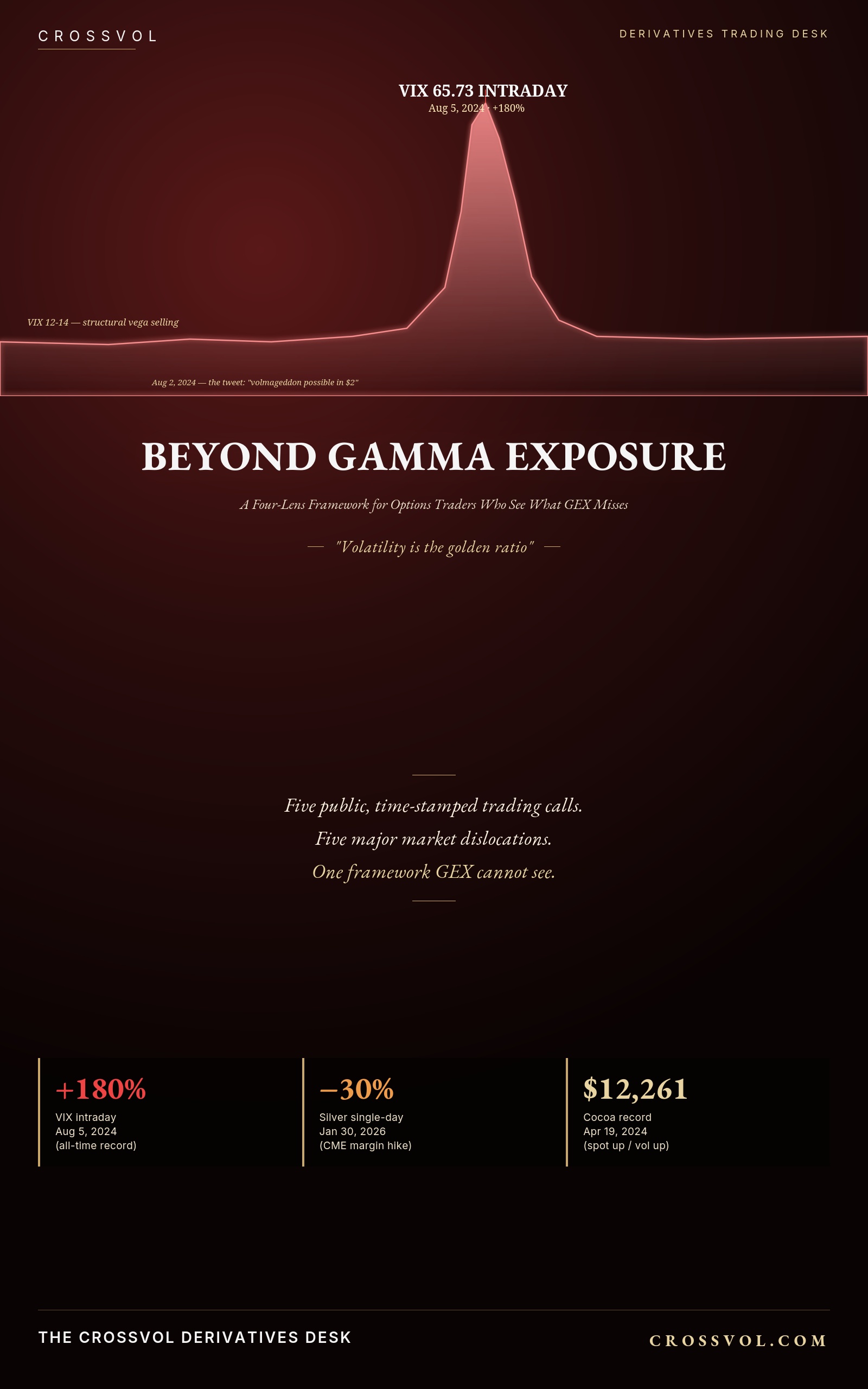
The companion book
Beyond Gamma Exposure
The 4-lens vol framework that backs the volatility trading course, distilled into 320 pages. The book stands on its own as a framework and the volatility trading course is the live application of that framework.
Frequently asked questions about the volatility trading course
Who is this volatility trading course for?
This volatility trading course is for traders who already know enough about options to understand that volatility itself is the asset. Aspiring vol traders, junior desk traders running their first vol books, portfolio managers using vol structures for hedging or yield, and quants building vol models. The volatility trading course is dense — it is not a starter options primer, it is a focused volatility trading course.
What makes this volatility trading course different?
Most products marketed as a volatility trading course barely go past defining implied volatility and recommending iron condors. This volatility trading course goes much further: full vol surface mechanics, skew dynamics, term structure, variance and dispersion, vega risk decomposition, regime detection. The team behind the volatility trading course runs real vol books — the course content reflects that practice instead of the marketing-first "trading academies" that dominate search results.
Do I need a math background for the volatility trading course?
A working comfort with high-school algebra, basic calculus concepts, and the standard options vocabulary (delta, vega, theta) is enough to follow this volatility trading course. The team derives every concept from first principles — you do not need a PhD to take the volatility trading course, but you do need to be intellectually serious about it.
What topics does the volatility trading course cover specifically?
The volatility trading course covers: vol as an asset class, implied vs realised vol, the full volatility surface (skew, smile, term structure), vol regime classification, variance swaps, volatility of volatility, dispersion trading, dealer vega, the short-vol crowd, and live volatility trade execution. The volatility trading course also covers the macro filter that shapes vol regimes.
How is the volatility trading course delivered?
180+ hours of structured video lessons hosted inside the Whop platform, plus a daily mentorship community where the desk posts live commentary on vol surface moves, dealer vega, and active vol trades. The volatility trading course is updated as markets evolve — when a new vol regime appears, the team records material on it.
How much does the volatility trading course cost?
Monthly subscription on Whop. Current pricing and any active promotion is visible live on the official Whop page. No annual commitment for the volatility trading course — pay month to month, cancel any time.
Does the volatility trading course cover dispersion?
Yes — extensively. Dispersion (long single-name vol, short index vol) is one of the most profitable structures on a vol desk and an entire module of the volatility trading course is dedicated to its pricing, hedging and live execution. This is one area where the volatility trading course is materially deeper than anything else publicly available.
Related across CrossVol
- Main training page
- Trading education
- Cross-asset approach
- Gamma exposure (GEX)
- Futures options
- Beyond Gamma Exposure — the book
- Derivatives trading course — the broader pillar landing
- Options trading course — options-first entry
- Gamma exposure course — dealer flow specialisation
- Live trading mentorship
- Institutional trading course
Join the CrossVol volatility trading course
The volatility trading course is open to new students every day on Whop. Instant access to 180+ hours of structured vol content plus the daily mentorship layer.